
The Green Firewall
Can Sarawak's rainforest be the last defence of our humanity?

On 1 January, Malaysia’s Online Safety Act 2025 (ONSA) officially came into force. Under this new regulatory regime, large platforms are now legally obligated to shoulder greater responsibility for the content they host – specifically material that facilitates harm or exerts “undue influence.” On the surface, the law is framed as a pragmatic safeguard for the vulnerable: children, teenagers, and those deemed most susceptible to the whims and fancy of an always-on digital ecosystem.
Yet, this moment warrants a reflection that extends beyond legal compliance. It invites a deeper interrogation of our collective relationship with the digital world and poses a more uncomfortable question: Who, exactly, is the “vulnerable” party?
Social media is frequently depicted in adversarial terms – manipulative, extractive, and cognitively corrosive. However, the prevailing assumption is that these risks are primarily a “youth problem,” and that mature adults possess the inherent discernment to navigate these spaces unaffected. In this view, “doomscrolling” is a generational affliction.
This assumption is comforting, but somewhat intellectually dishonest. The psychological levers that make social media so compelling – anxiety, outrage, and the craving for tribal identity – are fundamental human traits that do not magically disappear upon reaching adulthood. To suggest that maturity provides some form of immunity to algorithmic manipulation is a blatant myth.
In many ways, history repeats itself. Society has already lived through earlier iterations of what we now call social media. It used to be called the “news media.”
Facebook, Instagram, and TikTok are the latest evolution of mass media, technologically optimized for speed, suped-up convenience and hyper-personalization. The digitisation of paper and the shrinking of the computer into a handheld smartphone allows them to function as our primary conduits for news, lifestyle curation, and social signalling. Just as we once “subscribed” to newspapers, we now “follow” creators.
Nostalgia for the era of newsprint often overlooks its own excesses. Decades ago, the physical disposal of old newspapers was a genuine logistical burden; landfills were choked with newsprint that degraded far slower than expected for something that is universally known today as ‘environmentally friendly’. The crisis then, as it is now, was never really about the medium itself. It was about volume. The volume problem has merely migrated from the physical to the cognitive.
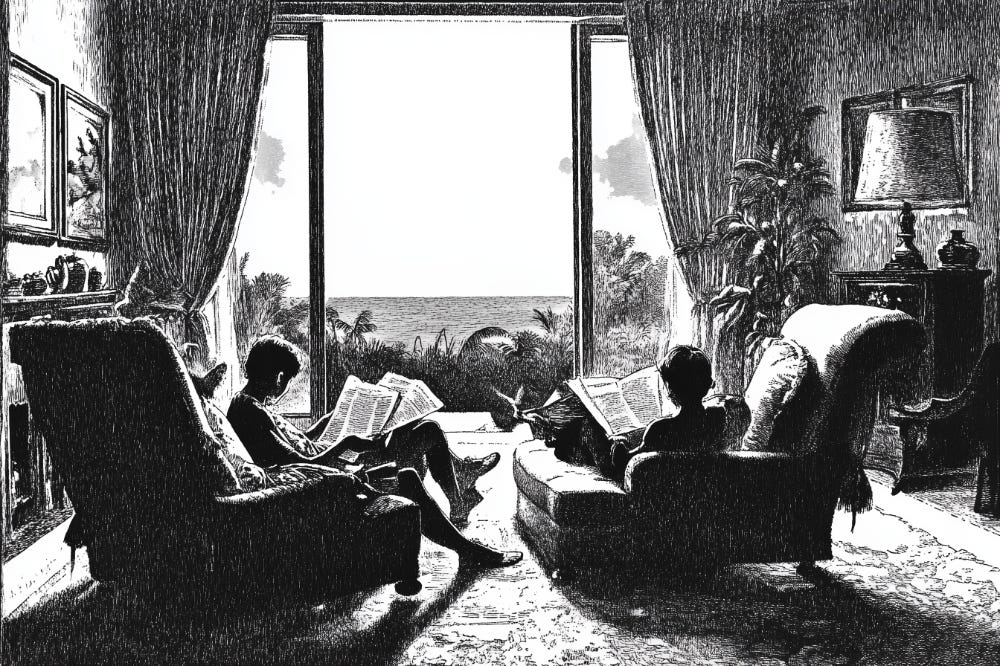
While the volume of content has reached a peak, our level of human connection has entered a profound deficit. This digital saturation has contributed to what The Economist has termed the “Relationship Recession.”
Changing social norms, and the paradoxical nature of dating apps have created a society that is more connected by Wi-Fi signals but more isolated in reality. Dating apps, ironically, have gamified connection, turning human companionship into a high-volume, low-stakes “feed” that mirrors the very scrolling behaviour that leads to fatigue. The result is a growing demographic of individuals who stay single longer and live alone in record numbers. The screen, once a tool to find a partner, has become a substitute for one.
Social media companies are driven by profit and we cannot expect them to self-edit. Regulation can barely keep up with rapidly evolving technology. The burden of defence falls to the individual. In a world where work and essential communication are intertwined with these platforms, “opting out” is often impossible. The response, then, lies in the deliberate cultivation of physical presence.
In this context, Sarawak offers a compelling case study in digital resistance. According to TikTok’s own metrics, Sarawak represents only about 1% of the approximately 30 million accounts based in Malaysia.
If this figure is truly representative of how little Sarawakians use social media, we may still have hope. It suggests that, for a while longer, a significant portion of our population remains unencumbered by the hypnotic “screen trap.” There is a fragile, beautiful innocence in this lag – a suggestion that the pace of life in the Land of the Hornbills is still governed by the immediate and the tangible.
In Sarawak, access to the sublime is not a distant luxury. The proximity of ancient forests, river systems, and rugged coastlines offers a vital counter-narrative to the digital feed. These environments do not demand “engagement metrics”; they operate on a geological timescale incompatible with the frantic pace of the scroll. Perhaps, in the end, our rainforest will come to rescue our humanity after all.
Regulation may protect the young but the ultimate fate of social media rests on a harder truth. If the industry continues to prioritize volume over value and algorithmic engagement over genuine human connection, it will simply collapse under the weight of its own excess, leaving behind a society that must learn, once again, how to look each other in the eye.
Thanks for your comments! It's hard to resist to think that modern problems are new when it's just new tools for the same human behaviours. Sarawak's geographical isolation does seem to offer a chance to observe before committing to the new trends that spread so fast elsewhere. I hope we take advantage of it and pay proper attention.